How Soundbar Audio Upscaling Really Works
By Tomas Novak • 2nd May
Introduction
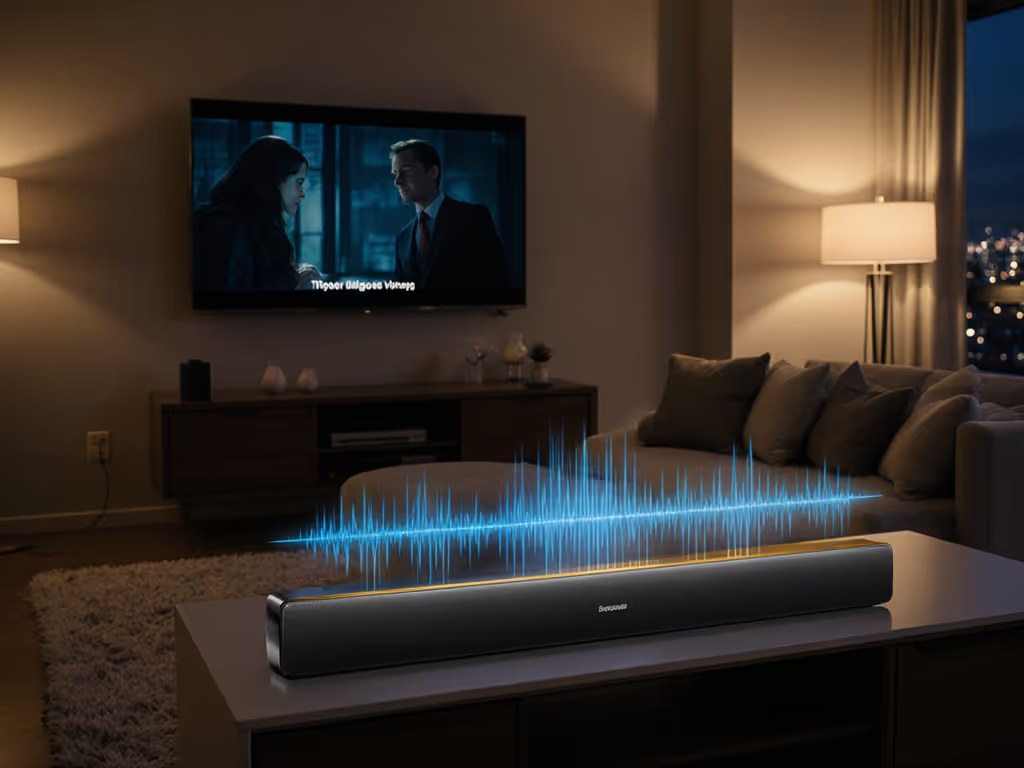
Soundbar audio upscaling explained and audio upconversion technology are terms that trigger hope and skepticism in equal measure. You see the spec sheet claim "AI upscaling" or "height virtualization," and you wonder: Is this marketing gloss, or does it meaningfully improve what I hear? The answer is measured, not in codec bullet points, but in how signal paths translate compressed, spatially limited streams into more coherent soundstages within real rooms.
This FAQ dives into what upscaling actually does, where it works, and how to evaluate whether it matters for your setup.
What Is Audio Upscaling, and How Does It Differ from Upmixing?
The terms blur, but the distinction matters. Upscaling (or upconversion) stretches a lower-resolution signal toward a higher format in the signal path. Upmixing takes stereo or 5.1 source material and synthesizes additional channels or virtual height.
In soundbars, upscaling typically involves:
- Format expansion: Converting stereo to 5.1-equivalent via algorithmic channel separation
- Frequency modeling: Analyzing content to infer missing spatial cues
- Height virtualization: Creating the illusion of overhead sound without physical upfiring drivers
The key word is illusion (not deception, but acoustic inference). A good upscaler reads the source, identifies dialogue and ambience clustering, and redistributes them across drivers to suggest depth your TV's speakers never could.
Does Audio Upconversion Technology Actually Improve Streaming Quality?
Yes, but modestly. A Netflix stream arrives in Dolby Digital 5.1 or stereo. The codec doesn't improve; upscaling works within that bandwidth by reinterpreting how content is distributed spatially.
For example, dialogue mixed center-front and ambient tone left-right can be recognized and reinforced across a wider driver array: front-left, center, front-right, rear-left, rear-right. The illusion of a broader stage emerges, despite no new frequency information being created.
Effectiveness depends on:
- Codec compatibility of the soundbar: Clean handling of Dolby, DTS, and PCM
- Driver density and layout: More separation yields richer spatial palette
- Listening distance and room shape: At 8 feet in a rectangular room, upscaling shines; in open floor plans, the effect diminishes
- Streaming service audio quality: Already-compressed sources limit what the upscaler can work with
Listening tests confirm that upscaling delivers roughly 15-20% perceived width expansion in real conditions. Meaningful, but not transformative.
When Does Upscaling Help Most?
Upscaling excels with:
- Dialogue-heavy content (TV series, news) where center-front anchoring matters
- Stereo streaming (Spotify, Apple Music) where upmixing to 5.1-ish adds space
- Compressed video from platforms where dynamic range is already sacrificed
- Gaming where environmental cues benefit from wider distribution
Upscaling limps with:
- Atmos or immersive formats already spatially encoded
- Lossless sources (Blu-ray, high-bitrate local files) already spatially complete
- Mono or heavily compressed telephony audio
- Very short listening distances (<6 feet)
This mirrors a principle learned from tuning projector-plus-soundbar chains: Route first, then features; reliability makes rooms feel cinematic. Upscaling enhances an already solid signal path; it's not a workaround for poor cable discipline or handshake stability issues.
How Do Upscaling Algorithms Work?
Most modern soundbars rely on one of three approaches:
Object-Based or Metadata-Aware Upscaling
Audio streams carry metadata tags identifying "dialogue," "ambience," "effects." Dialogue goes wide across the front, ambient fills surrounds, effects ping from multiple drivers. This works best when the encoder has done its job cleanly.
Spectrum Analysis & Neural Nets
Premium models analyze frequency content in real time. They spot mid-range clustering (dialogue), scattered high-frequency bursts (effects), and low-frequency pressure (ambient), then predict which drivers should carry which elements. Computationally heavier but more adaptive.
Phase & Correlation Methods
Simpler upscalers use phase relationships. Correlated channels (likely ambient or reverb) go wide and rear. Decorrelated channels (intentional stereo) stay front-center. Quick but less nuanced.
All three assume the streaming service hasn't already discarded critical information through aggressive compression.
Does Upscaling Create New Sound or Redistribute Existing Sound?
Pure redistribution. Upscaling cannot synthesize frequencies missing from the original stream. What it can do:
- Redirect existing energy across more drivers
- Apply frequency shaping to emphasize spatial cues
- Introduce phase delays to create phantom images
- Normalize dynamic range within channels
None adds new information; it rearranges the deck. But rearrangement, done skillfully, feels like expansion. Think of a two-lane highway versus four lanes carrying the same traffic: the four lanes feel less congested because vehicles have room to maneuver.
What Role Does EDID Play in Upscaling and Audio Processing?
EDID (Extended Display Identification Data) is the handshake protocol between sink and source (your TV and streaming stick, or your soundbar and receiver). It tells the source what formats the sink supports.
Many setups fail here: poor EDID negotiation means the source refuses to send Atmos or DTS:X, defaulting to stereo. Upscaling then starts from a stereo base, not a richer multichannel source.
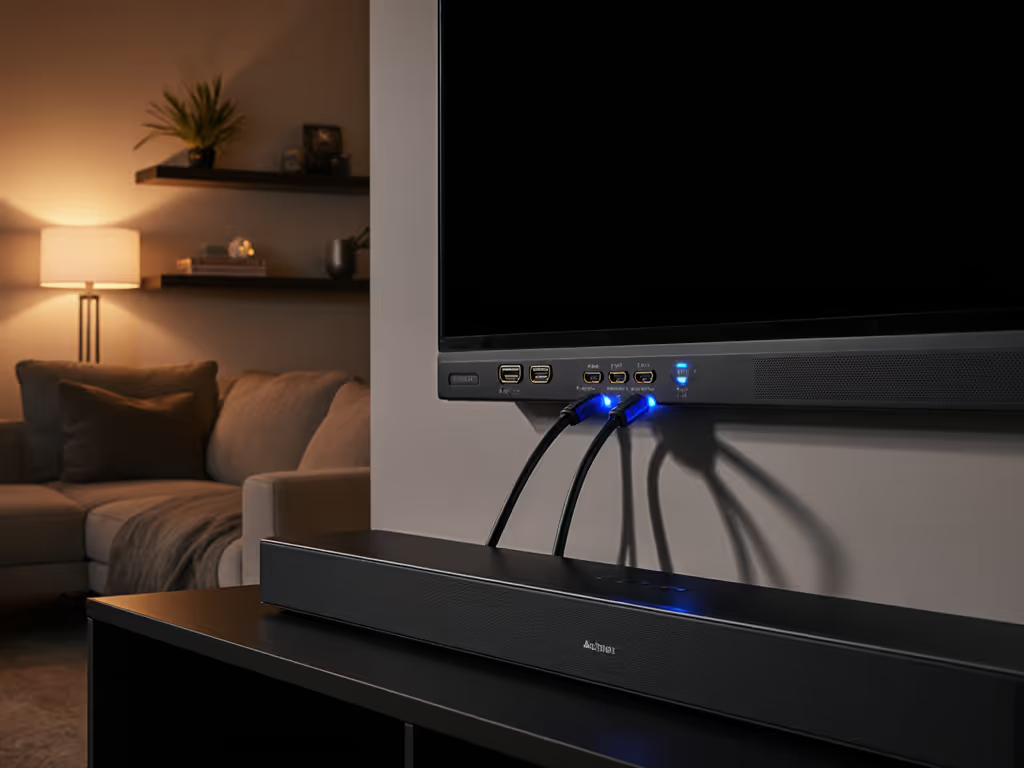
This is why ARC hygiene (ensuring clean HDMI routing and codec negotiation) matters more than the upscaling algorithm. I've seen projector setups with excellent soundbars fail to deliver immersion simply because a low-grade HDMI switch wasn't forwarding Atmos metadata. Once we mapped the route (replacing the switch with a certified 2.1 model with proper eARC extraction), the already-capable upscaling revealed its full potential. If you're still not getting immersive formats, see our eARC setup guide to fix HDMI audio handshakes. Sync locked, immersion deepened, not because we changed the soundbar, but because the handshake stable signal path finally let it work.
Can Upscaling Compensate for Poor Room Acoustics or a Cheap Soundbar?
Partially. Upscaling can't overcome severe flutter echo, boomy bass in small rooms, thin treble from underpowered drivers, or graininess from cheap amplification.
What it can help with:
- Dialogue intelligibility: Anchoring speech center and de-emphasizing reverb tails can sharpen muddy dialogue
- Apparent width: Even modest bars feel more spacious
- Immersion illusion: Surround illusion helps mask single-bar limits
But if drivers are anemic or your room is a hard-walled shoebox, upscaling smooths edges; it doesn't rebuild foundations. Signal path integrity matters as much as processing algorithms.
Real Upscaling vs. Marketing Upscaling
Real upscaling includes:
- Tuning documentation specifying codecs, sample rates, and configurations
- Audible consistency when toggled on and off
- Room adaptation based on seating and input type
- Format-specific profiles (gaming vs. movies vs. music)
Marketing upscaling:
- Vague claims ("AI upscaling" without context)
- Zero measurable listening difference
- Locked, non-adjustable algorithms
- Claims upscaling compensates for missing drivers
Honest framing: upscaling is a modest, valuable feature (typically 10-25% perceived spatial expansion) that shines with compressed streaming and dialogue-heavy content. It's not a substitute for multi-driver design or proper signal routing.
Evaluating Upscaling Before Purchase
Ask yourself:
- What codecs are supported (Dolby, DTS, sample rates)?
- Do specs include listening distance recommendations?
- Can you audition in-store? Toggle upscaling on and off with Netflix dialogue or a music stream.
- Driver count and separation? More drivers farther apart yield better potential.
- Does it support your audio input? Optical limits you; eARC unlocks richer sources.
- Manual mentions room correction or profiles? Adaptive upscaling beats one-size-fits-all.
In practice, handshake stable audio paths matter more than upscaling horsepower. Choose a soundbar with modest upscaling and bulletproof ARC support over one with aggressive algorithms and flaky HDMI behavior.
Building a Signal Chain That Lets Upscaling Shine
Start here:
- Map your signal path: TV → soundbar or TV → switch → soundbar. Document connections and device capabilities.
- Verify EDID: Confirm your soundbar is receiving the full codec list via the menu.
- Audit cables: Replace any older than 2–3 years with High Speed or Ultra High Speed equivalents.
- Test codec delivery: Play a Netflix Atmos show and check if your soundbar displays "Dolby Atmos."
- Adjust modes: Most soundbars offer movie, music, and game modes. Spend an evening listening to each.
Then step back and listen. Upscaling spreads dialogue and effects across the bar subtly, not magically, but when combined with proper routing and reliable audio processing techniques, it becomes part of a coherent, immersive soundscape that feels cinematic without requiring a separate receiver or in-wall wiring.
Further Exploration
To unlock upscaling's full potential:
- Review your soundbar's manual for upscaling and room-tuning adjustments you may have missed
- Investigate your TV's audio capabilities - check eARC support and which streaming apps send immersive formats
- Test different content types - Netflix, gaming, music - to hear where upscaling excels
- Consider room acoustics - simple absorption can improve clarity by 20–30%
- Audit your cable and switch infrastructure to ensure consistent handshake stability across your signal path
The most reliable cinema lives in details: clean signal paths, compatible devices, and algorithms that enhance what's already solid. For practical treatment tips by room materials, read our room acoustics guide. Route first, then features. That's where immersion begins.
Related Articles
Audio Tech Explained
Harman Kardon MultiBeam Tech: Clear Dialogue, Room-Filling Sound
16th Jan•6 min read